The Caterpillar 325F is a 25-tonne-class hydraulic excavator built in the early-to-mid 2010s, and it is still one of the most common mid-size machines on the used market. It is big enough for serious excavation and truck loading, yet small enough to move on a standard lowboy. This guide skips the brochure talk and covers what matters to someone buying, running or maintaining one: how to read the serial number, what it really costs per hour, what to inspect at different hour counts, and how it compares with the machines around it.
Cat 325F at a Glance
Exact figures vary by configuration, shoe width, boom and stick, and market, so treat these as the typical range and confirm against the machine's own documentation.
- Class: about 25 to 27 tonnes (roughly 55,000 to 60,000 lb) operating weight
- Engine: Cat C7.1 ACERT diesel, in the neighborhood of 185 hp
- Typical work: general excavation, trenching, truck loading, site prep, utility and pipeline work
- Emissions: depends on market and build date. Later North American machines use a more complex aftertreatment system than earlier ones (VERIFY by serial number)
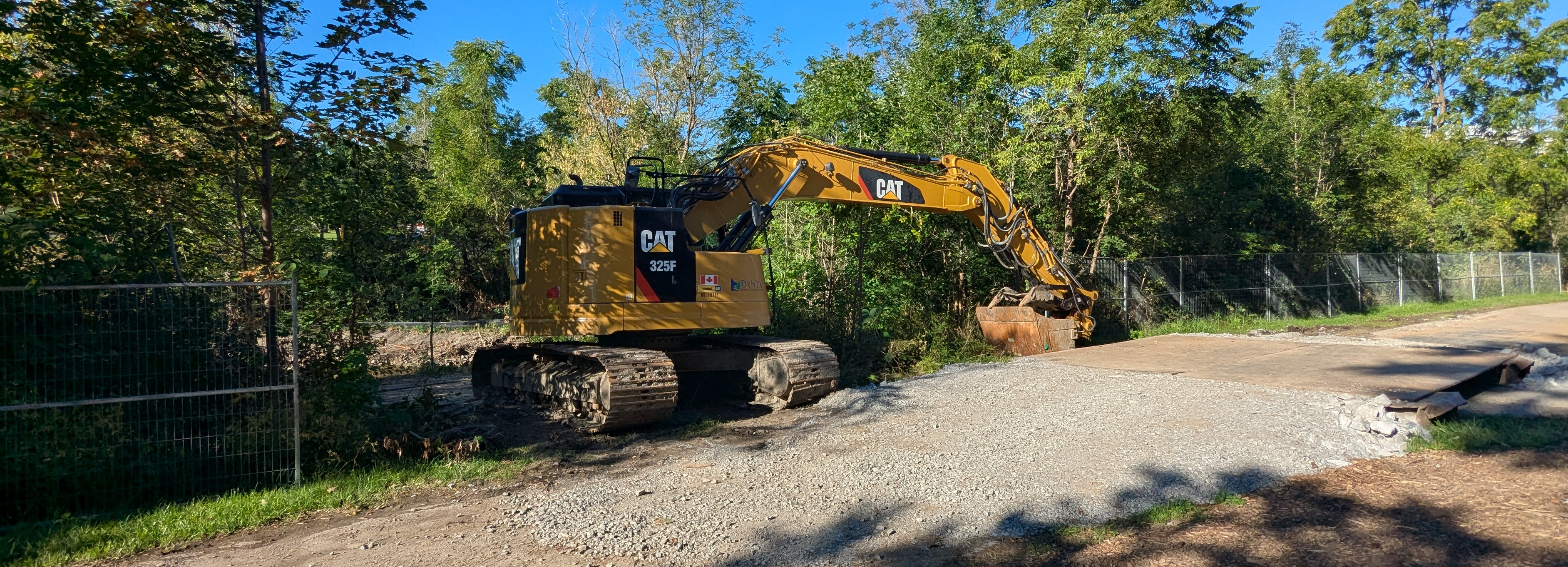
325F Variants: L vs. L CR
The two configurations you will see most often are the 325F L and the 325F L CR. Both share the same engine and the same basic hydraulics. The difference is in the swing geometry, and that decides which one suits your jobs.
325F L
Undercarriage
Long, standard
Stability
Best for heavy digging and lifting
Best for
Open sites, mass excavation
Trade-off
Hard to use beside walls or traffic
325F L CR
Undercarriage
Long, standard
Tail swing
Compact radius (reduced)
Stability
Good, but check lift charts
Best for
Roadwork, urban jobs, tight sites
Trade-off
Less common, so harder to find used
If your work is mostly open ground, the standard L is the easy choice and the easier machine to find. If you regularly work inside a lane closure or against a building, the CR can save you real time because you stop repositioning to clear the counterweight.
How to Find the Serial Number and Date a 325F
Before you pay for any used machine, confirm that its paperwork matches the machine in front of you. Cat serial numbers follow a three-letter prefix followed by five digits. Newer machines also carry a longer product identification number (PIN) that includes the model and the serial number.
- Look for the plate on the machine's frame and check the operator's manual for the exact location on your build.
- Compare it with the stamped number on the frame. A plate that does not match the stamping is a red flag.
- Check the engine plate separately. The engine has its own serial number. A mismatch can simply mean a replacement engine, but it should be explained and documented.
- Get the build date from a Cat dealer. Give them the serial number and they can tell you build date, original configuration and any open service campaigns.
Documents and Records to Ask For
A used excavator is only as trustworthy as its paper trail. Before you travel to inspect one, ask the seller for:
- Proof of ownership: a title or bill of sale, plus a lien search so you do not buy a machine that someone else still has a loan against.
- Service records: oil and filter changes, and invoices for any major repair, with dates and hour readings.
- Fluid analysis reports: engine, hydraulic and final drive oil samples show wear long before it becomes a failure. Cat dealers offer an S·O·S fluid analysis program for this.
- Undercarriage measurements: a recent wear report, and invoices for any replacement tracks, rollers or sprockets.
- Telematics history: if the machine has Cat Product Link fitted, a dealer may be able to confirm hours and fault history from the serial number (VERIFY availability for your machine).
What a 325F Really Costs per Hour
Sellers quote purchase price. Owners live with hourly cost. Build your own number from these parts, using your fuel price and your site conditions:
- Fuel: machines in this class commonly burn somewhere in the range of 4 to 7 US gallons (15 to 26 liters) per hour, depending heavily on duty cycle and mode selection. Multiply by your diesel price.
- Undercarriage wear: often the single biggest wear cost on any excavator. Rock, abrasive soil and constant track spinning drive it up sharply.
- Scheduled service: engine oil, filters, hydraulic and final-drive fluids, spread across the service interval.
- Ground-engaging tools: cutting edges, teeth and adapters, which depend on the material you dig.
- Repairs reserve: hoses, pins and bushings, pumps and electronics. Set a per-hour reserve instead of being surprised by it.
- Depreciation and financing: the cost that stays on the books whether the machine works or not.
A useful habit is to track fuel and service costs per hour for the first six months and use your own data from then on. Your site's actual number will be more reliable than any published average.
Used 325F Inspection Checklist by Hour Count
Hours alone do not tell you much. What matters is what the hours were spent doing. Use the cards below to decide where to focus your attention.
Under 5,000 Hours
Undercarriage
Measure; should have plenty of life left
Pins and bushings
Look for early play at the boom foot and stick
Hydraulics
Check hose condition and cylinder rod finish
Engine
Verify service records; check for warning history
Biggest risk
Abuse or neglect despite low hours
5,000 to 10,000 Hours
Undercarriage
Likely mid-life; get actual wear measurements
Pins and bushings
Expect measurable wear; ask what was replaced
Hydraulics
Test cycle times; feel for weak or hot pumps
Swing
Check swing bearing play and drive noise
Biggest risk
Deferred maintenance finally coming due
10,000+ Hours
Undercarriage
Probably replaced once; ask for the invoice
Pins and bushings
Check for rebuilds and line-boring work
Hydraulics
Look for overhauled pumps and motors
Engine
Ask about rebuilds; test cold start and blow-by
Biggest risk
Several wear items failing close together
Whatever the hour count, do these basics on every machine: start it cold, run every function through full travel, watch for leaks while warm, check for fresh paint over cracks near the boom and stick, and pull a fluid sample if the seller allows it. A neutral lab analysis is cheap compared with the cost of a bad pump.
Where to Look First: Common Weak Points
No machine is trouble-free. Instead of repeating forum rumors, these are the areas worth checking on any 325F-class excavator, and the first places to ask a dealer about service bulletins for your serial number.
- Emissions aftertreatment: on later machines, ask for the fault history and the condition of the DEF system (VERIFY which systems apply to the machine you are buying).
- Hydraulic hoses and lines: abrasion where hoses rub the boom or frame, and weeping fittings.
- Boom, stick and bucket pins and bushings: sloppy joints show up as clunking and uneven bucket wear.
- Swing bearing and swing drive: excessive play or grinding noises.
- Track components: uneven wear on one side often points to alignment or tension problems.
- Cab electronics and air conditioning: annoying, and often costly if left until last.
Red Flags That Should Make You Walk Away
Some warning signs are worth more than any price discount. Be ready to leave if you see any of these:
- The seller will not allow a cold start, a fluid sample or an independent inspection.
- The machine is already warmed up when you arrive, or the engine bay has been freshly pressure-washed or painted.
- The hour meter does not match the wear. A low-hour machine with a worn seat, pedals and pins is suspicious.
- The serial plate is missing, damaged or does not match the stamped number.
- There are welds, cracks or fresh paint on the boom, stick or frame with no repair documentation.
- Oil or hydraulic fluid looks milky, sludgy or contaminated with metal.
- Only one side of the undercarriage has been replaced, which suggests partial work or an unresolved alignment problem.
Maintenance Schedule
Intervals below are typical for machines in this class. The Operation and Maintenance Manual for your machine is the authority, and shorter intervals are wise in dusty, hot or severe conditions.
- Daily or every 10 hours: walkaround, fluid levels, grease the bucket linkage, drain water from the fuel system if equipped
- Every 50 hours: grease the boom, stick and swing components as specified in the OMM
- Every 500 hours: engine oil and filter, fuel filters
- Every 1,000 hours: hydraulic return and pilot filters, swing drive oil check
- Every 2,000 hours: final drive oil and other long-interval items
- Long interval: hydraulic oil change, with the interval depending heavily on the oil type used
Keep every service record. A machine with a complete paper trail is worth noticeably more than an identical one without, and it makes problems far easier to diagnose.
Operating Habits That Cut Fuel and Wear
How a machine is run affects hourly cost as much as how it is built. These habits cost nothing and add up over thousands of hours:
- Match the power mode to the job. Use a lower or economy mode for light digging and save full power for heavy work (VERIFY mode names on your machine).
- Cut idle time. Shut the engine down during long waits, or use automatic idle features if the machine has them.
- Reduce swing angle and travel. Position the machine and the truck so the bucket makes the shortest trip.
- Turn gradually. Sharp pivot turns and track spinning on abrasive ground wear the undercarriage quickly.
- Keep tracks clean and correctly tensioned. Packed mud and wrong tension both accelerate wear.
- Avoid slamming cylinders at the end of their stroke. It shocks pins, bushings and the cylinders themselves.
- Warm up the hydraulics in cold weather before heavy work.
Wear Parts: OEM vs. Aftermarket vs. Used
Parts are where most owners can save money, and also where the most expensive mistakes are made. Here is how the three sources compare.
Genuine Cat (OEM)
Fit
Exact, backed by the dealer
Lifespan
Consistent and well documented
Best for
Engine, hydraulic and electronic parts
Watch out
Price, and availability lead times
Quality Aftermarket
Fit
Usually good from established brands
Lifespan
Varies by brand and material
Best for
Filters, teeth, cutting edges, track pads
Watch out
Unbranded copies with weak steel
Used / Surplus
Fit
Must match model and serial range
Lifespan
Unknown; depends on the donor
Best for
Cab parts, panels, major castings
Watch out
No warranty; verify part numbers
325F vs. the Machines Around It
If a 325F is not quite right, the next question is usually whether to go one size up or down. Here are the closest neighbors in the same F-series family.
Cat 323F L
Power
Roughly 150 to 160 hp
Best for
Lighter trenching and utility work
Trade-off
Less lift and reach than a 325F
Cat 325F L
Best for
General excavation and loading
Trade-off
Heavier to move than a 323F
Cat 326F L
Power
Roughly 185 to 190 hp
Best for
Buyers wanting a little more capacity
Trade-off
Small step up; compare prices carefully
Cat 330F L
Best for
Heavy excavation, rock, bigger trucks
Trade-off
Higher transport and running costs
Figures are approximate and vary by configuration (VERIFY against Cat spec sheets). Cat has since replaced much of this lineup with its Next Generation machines, which are worth a look if your budget allows newer equipment.
Transport and Job-Site Logistics
A 25-tonne machine is heavy enough to need planning. Before you buy, confirm these with the seller or the spec sheet for the exact configuration:
- Shipping weight and width with the shoes and counterweight actually fitted, since these change with configuration and can affect permit requirements.
- Transport height with the boom folded, which matters for bridges and trailer decks.
- Trailer capacity with a margin for attachments and tools carried on the trailer.
- Shoe width for ground pressure on soft sites, and for how it changes your travel width.
Attachments and Couplers
Many 325F machines come with a quick coupler, which makes switching between buckets, thumbs and hammers far faster. If you plan to run a hydraulic hammer or other powered attachment, check that the machine has the auxiliary hydraulic circuit and the correct plumbing, and size the attachment to the machine's published flow and pressure instead of guessing. Confirm the coupler type before buying any attachment, because pin spacing and coupler style must match.
Frequently Asked Questions
How much does a Cat 325F weigh?
Roughly 25 to 27 tonnes (55,000 to 60,000 lb) depending on configuration. Check the spec sheet for your exact machine.
What engine does the Cat 325F use?
A Cat C7.1 ACERT diesel, rated at about 185 hp.
How much fuel does a Cat 325F burn per hour?
Machines in this class commonly burn about 4 to 7 US gallons (15 to 26 liters) per hour, depending on the work, the power mode and the operator. Track your own fuel use for a few weeks to get a number you can trust.
Is the Cat 325F a good machine to buy used?
It is a widely used machine with broad parts and dealer support, which makes it easier to own than many alternatives. As with any used excavator, condition and maintenance history matter more than the model name.
How many hours is too many on a used 325F?
There is no single cutoff. A well-maintained machine at 10,000 hours can be a better buy than a neglected one at 5,000. Maintenance records and component wear measurements tell you more than the hour meter.
What is the difference between a 325F L and a 325F L CR?
Both share the same engine and long undercarriage. The CR has a reduced tail swing radius, making it easier to use on tight or traffic-restricted sites.
Can a 325F run a hydraulic hammer?
Many can, but the machine needs the auxiliary hydraulic circuit and plumbing, and the hammer must be sized to the machine's flow and pressure. Check with a dealer or attachment supplier before buying.
Where is the serial number on a Cat 325F?
On the machine's identification plate and stamped on the frame. Check the operator's manual for the exact location, and have a Cat dealer decode the build date from the serial number.
Related Reading
Last Update: October 2026
